New Yorkers Benefit from an initiative of NYC REACH & NYC Treats Tobacco
Tobacco use is the leading cause of preventable death and disease in the United States, causing 1 in 6 deaths every year. Children exposed to smoke are more likely to have bronchitis, asthma attacks, pneumonia, and sudden infant death syndrome (SIDS). While only 1 in 10 New Yorkers smoke, tobacco use leads to higher rates of morbidity and mortality, as well as increased healthcare-related costs. Across the whole of New York State, smoking causes $12.07 billion in health care costs and $18.2 billion in lost productivity costs annually.
Two-thirds of smokers are interested in quitting. Those who are assisted by a provider double their odds of successfully stopping. Consequently, the NY State Bureau of Tobacco Control has funded NYC Treats Tobacco, the NYC grantee of their Health Systems for a Tobacco Free NY grant program. Through this initiative, NYC Treats Tobacco, based at New York University, and NYC REACH provide tailored support to health care providers to implement evidence-based practices to treat tobacco use. NYC REACH aims to support primary care across NYC and was born from a partnership between the NYC Health Department and the Fund for Public Health.
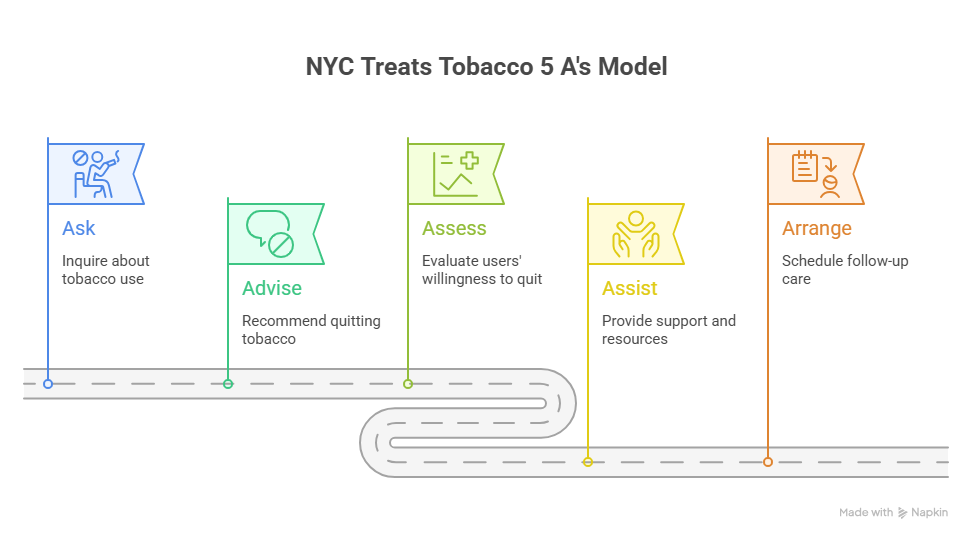
NYC Treats Tobacco helps health systems set up the “5 A’s” model for treating tobacco use and dependence: “Ask”, “Advise”, “Assess”, Assist”, “Arrange”. This evidence-based guide ensures that all patients are screened for tobacco use and, if required, patients are provided counseling, medications, referrals to additional resources, and follow-up. NYC Treats Tobacco and NYC REACH provide technical assistance to update health center workflows and electronic health records, trainings on tobacco counseling and motivational interviewing, free Nicotine Replacement Therapy, and tailored policy creation to update their procedures.
The CDC’s Office on Smoking and Health had provided federal leadership and $260 million in funding to prevent smoking every year. The office was eliminated in April 2025. It’s more important now than ever before to ensure there’s clear guidance and support to address this issue.
From 2022 to 2025, the NYC Treats Tobacco team has partnered with 50 health care organizations serving over 3.3 million patients combined. These health centers serve particularly vulnerable populations, like those on Medicaid, those with mental health disorders, and those who live in neighborhoods with a high density of tobacco retailers. Many of these populations have twice the average rate of smoking. In NYC, the prevalence of tobacco use reflects systemic inequities in the city, and NYC Treats Tobacco aims to close those gaps.
In New York City, tobacco use is down to 8.4%, a record low since recording began in 1985. However, there are still stark disparities among people with disabilities, enrolled in Medicaid, reporting frequent mental distress, and the unemployed. In addition, new threats are emerging. Among NYC public high school students, vaping is over three times more common than cigarette smoking (4% vs. 14%) and over seven times more common among young adults (2% vs. 15%). Vaping often leads to tobacco use. One study found that 27.5% of young people who started vaping in 2018 began smoking cigarettes the following year, compared to only 2.4% of their non-vaping peers.
NYC Treats Tobacco and NYC REACH plan to continue working with health centers across settings, including primary care, behavioral health organizations, and school-based health centers. If you are interested in learning more or partnering with the team, please reach out to Mikayla Hyman, NYC REACH Project Manager, at mhyman2@health.nyc.gov.