
This is the second of a two-part series about the dangers of hot weather and how New Yorkers can stay safe. In this post, we explore using pop-up cooling stations in neighborhoods around NYC.
At a glance:
- FPHNYC and the NYC Health Department contracted with seven community-based organizations to operate pop-up cooling stations during the summer heat.
- Stations targeted outdoor workers, immigrant New Yorkers, older adults, and residents without home air conditioning in neighborhoods with the highest Heat Vulnerability Index scores.
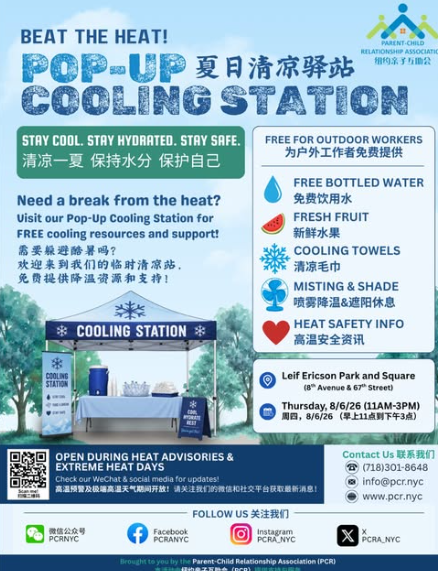
- Each station offered a tent, misting, shade, and drinking water, with community groups adding their own programming and resources.
Heat kills more New Yorkers each year than any other weather hazard, roughly 500 people annually, according to the NYC Health Department’s 2026 Heat-Related Mortality Report (covered in a recent FPHNYC blog post about managing the dangers of hot weather). Most of those deaths happen at home, in apartments without working air conditioning. But many heat-vulnerable New Yorkers are not at home during the hottest hours of the day. They’re outside: delivering food, building buildings, selling goods on the sidewalk, waiting for a bus. That’s the gap that pop-up cooling stations are built to close.
“It’s a silent population,” said Laura Bozzi, Executive Director of Environmental Health Policy at the NYC Health Department. “And we all depend on them.”
The pop-up stations are one piece of a greater effort that also includes outreach around utility benefits and energy assistance programs. As Bozzi puts it, “Even if you have an air conditioner, can you afford to run it?”
What is a pop-up cooling station?
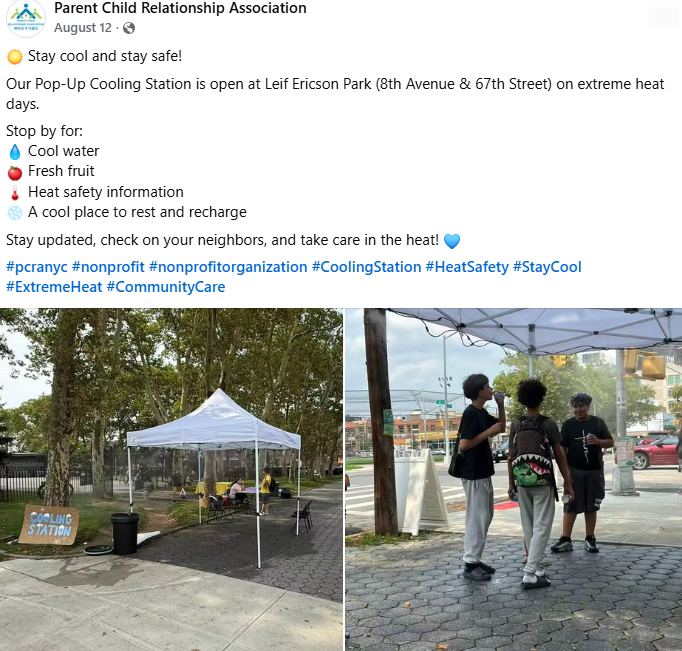
A pop-up cooling station is exactly what it sounds like: a transportable setup with a tent, misting, shade, and drinking water that a community organization can bring directly to the people who need it, rather than asking heat-vulnerable New Yorkers to find their way to a fixed cooling center. FPHNYC and the Health Department piloted the model in summer 2025 and expanded it in 2026.
The seven community-based organizations (CBOs) selected for the program were the Parent Child Relationship Association; Project Hospitality, Inc.; New Immigrant Community Empowerment, Inc.; Mexican Coalition for the Empowerment of Youth and Families, Inc.; Apostolic Assembly of The Faith In Jesus Christ; 34th Avenue Open Streets Coalition; and African International Collaborative.
These CBOs deployed their stations on days when the National Weather Service issued a heat advisory or the heat index topped 82°F. Some CBOs also added health fair resources, cooking demonstrations, and language classes alongside the misting tents and water.
Why outreach, not just infrastructure, matters
Outdoor workers and recent immigrants are less likely to know where a cooling center is, less able to leave a job site during working hours, and, in some cases, wary of engaging with city services directly. Routing this program through trusted community organizations, rather than city agencies alone, is meant to close that trust and awareness gap.
The program is also one piece of a larger citywide push. When heat indices climbed toward 109°F this summer, among the hottest days in city history, Mayor Mamdani activated the city’s Heat Emergency Plan, which expanded pop-up cooling stations, initiated in-home wellness checks for older adults, and extended pool hours.
Frequently asked questions
- Who can use a pop-up cooling station? Anyone. The stations are set up in public locations and designed especially for outdoor workers and community members without other ways to cool down, but they’re open to anyone who needs relief from the heat.
- How is this different from a Health Department cooling center? Cooling centers are fixed indoor locations, several of them recently added at Neighborhood Health Action Centers in Brownsville, East Harlem, and Tremont. Pop-up cooling stations are mobile and outdoor, designed to reach people during the workday rather than asking them to travel to an indoor site.
- How can I find or access cooling resources? Locate air-conditioned public spaces near you at finder.nyc.gov/coolingcenters or call 311.