

After over two years of planning and development, in 2025, the NYC Health Department launched the NYC Breast Cancer Task Force (NYC BCTF), a 5-year initiative led by the Health Department’s Cancer Prevention and Control Program.
Breast cancer affects 1 in 8 women in the United States. In New York City, approximately 6,400 people receive a breast cancer diagnosis each year, and around 1,000 lives are lost. Non-Hispanic Black women are more likely to be diagnosed with breast cancer at later stages and have a 40% greater mortality rate than white women. This higher mortality rate is all the more striking when juxtaposed against the fact that White women have the highest incidence rate of racial groups surveyed.

How can public health explain and tackle this mortality gap? Traditionally, public health approaches to cancer have focused on promoting screening. Yet in the case of breast cancer disparities in NYC, data suggest that more screening will not close the gap. In fact, analyses conducted by the Cancer Prevention and Control program show that in NYC, Black and white New Yorkers report getting mammography at comparable rates. Mammography rates in NYC are actually a remarkable success story of equitable access. Yet the mortality gap persists.
Since the observed mortality gap will not be closed solely through additional screening, the Health Department formed the NYC BCTF to bring together stakeholders from across NYC with expertise in the full range of factors that may influence breast cancer mortality rates. These include racial patterns in subtypes of cancer, access to timely follow-up and treatment, quality of care, and supportive services to ensure treatment completion. Inspiration and valuable guidance for the task force also come from the achievements of Chicago’s Metropolitan Breast Cancer Task Force in reducing the racial mortality gap in breast cancer within their city.
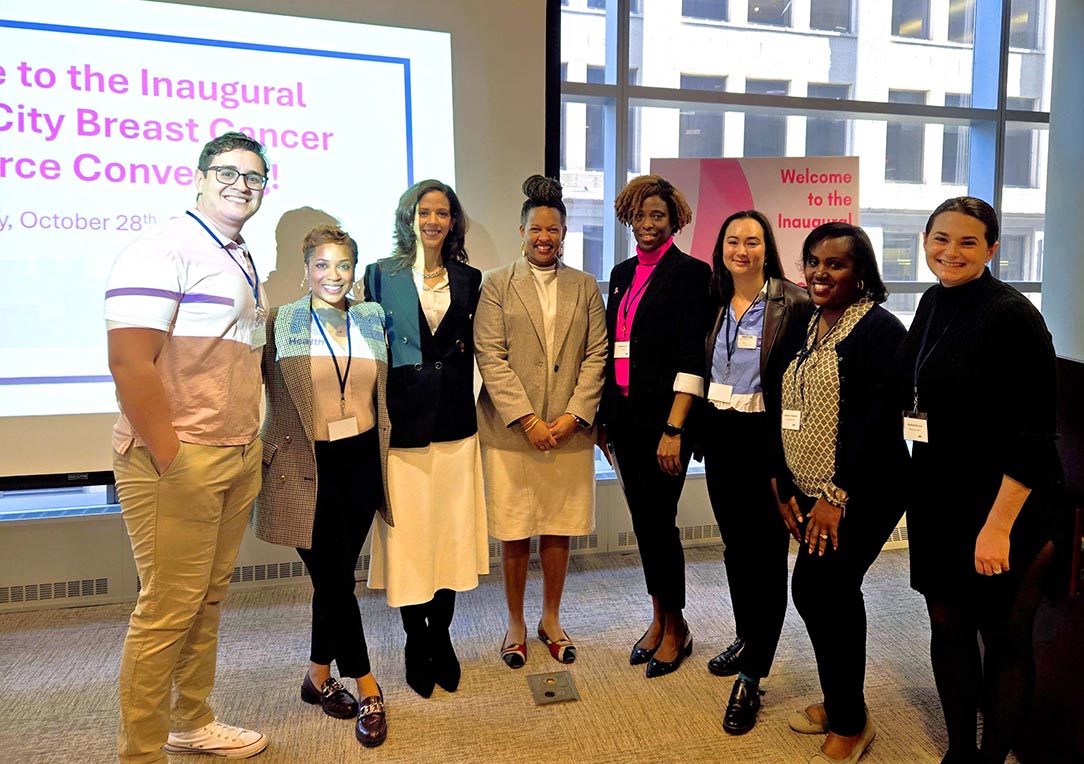
NYC Health Department staff celebrate the launch of the NYC Breast Cancer Task Force with partners from the American Cancer Society at the kickoff convening on October 28, 2025
The NYCBCTF held its inaugural in-person convening in October 2025, kicking off the work with an address by then Acting Commissioner Michelle Morse. The event brought together stakeholders from groups including major health systems, including Memorial Sloan Kettering, Montefiore, NYC Health + Hospitals, Mount Sinai, NYU Langone, and others, alongside research institutions and community organizations such as the American Cancer Society, SHARE Cancer Support, AfroPink, and Karen’s Club.
By spring of 2026, the NYCBCTF had grown to 90 individuals from health systems, research institutions, insurance providers, community-based organizations, survivors, and patient advocacy groups, who examine what happens before and after screening. Members of the NYC BCTF commit to individual projects aimed at answering key questions across the breast care continuum: how quickly does a patient receive a follow-up test after an abnormal mammogram? How long does it take for the patient to receive treatment after their diagnosis? Do patients have access to genetic testing, patient navigation, and culturally competent support along the way? Does the data suggest different timeliness of breast cancer care for Black women compared to other groups?

Participants engage in focused discussions during the breakout sessions at the inaugural convening of the NYC Breast Cancer Task Force
Over the next few years, the NYC BCTF will lead the development of a strategy map for NYC to address the drivers of the mortality gap between Black and White women across the full cancer continuum: before, during, and after diagnosis. As task force members share and collaborate on successful interventions, many of these can be scaled citywide as strategies that can finally move the needle on this health inequity that has persisted for far too long.
Every New Yorker deserves equitable, high-quality cancer care, and the NYC Breast Cancer Task Force is helping make this a reality. FPHNYC is proud to help make this critical work possible by securing generous sponsorship support from Genentech, a member of the Roche Group.
Genentech is focusing our efforts where there is greatest need and where we can have the greatest impact, working hand-in-hand with local experts, organizations and health care systems to break dwn barriers to care.
Visit the NYC Health Department’s website for information and resources about breast cancer.
Contact the NYC Breast Cancer Task Force team via email: breastcancer@health.nyc.gov
