
In 2025, the NYC Health Department made notable strides in improving the health and well-being of New Yorkers, including increased life expectancy, sharp declines in overdose deaths, and expanded support for mothers and families. You can read about many of these noteworthy public health achievements on the Health Department’s website.
As the dedicated nonprofit partner of the Health Department, the Fund for Public Health NYC (FPHNYC) plays an active and vital role in the ongoing work to protect and improve the health of everyone who lives, works, or visits NYC. Many of the recent public health achievements benefiting New Yorkers are the result of programs and initiatives FPHNYC has coordinated in partnership with the Health Department, community-based organizations (CBOs), and public and private funders.
Life Expectancy Reaches All-Time High
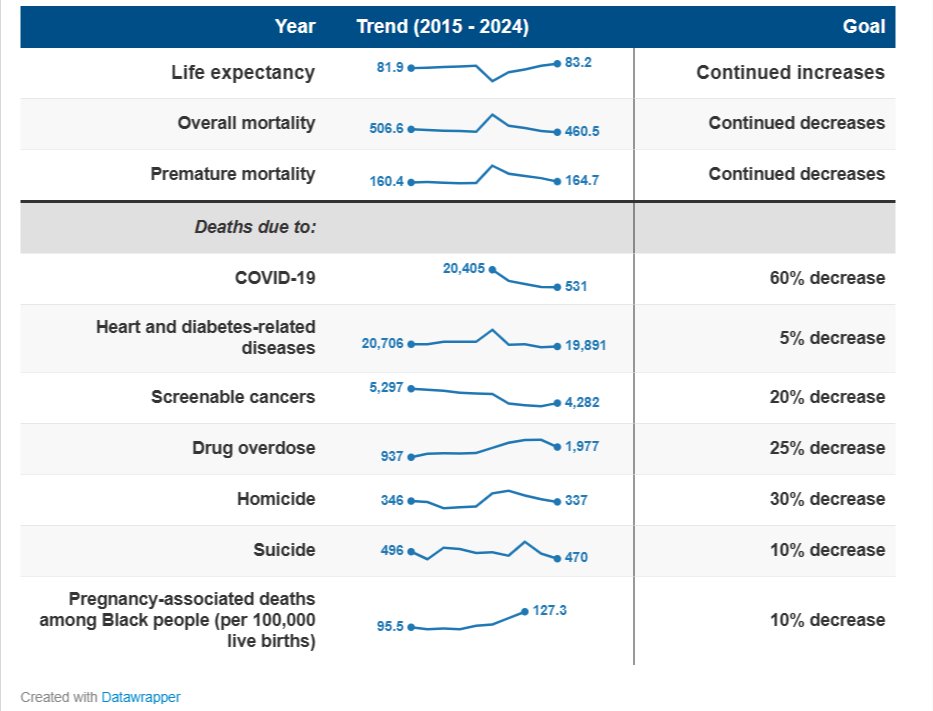
A noteworthy increase in citywide life expectancy to an all-time high of 83.2 years is mainly attributable to a sharp decline in COVID-19 death rates across all racial and ethnic groups. Since the introduction of COVID-19 vaccines, FPHNYC has helped make vaccinations accessible to every New Yorker through programs in collaboration with faith and community-based organizations, Federally Qualified Health Centers, and pediatricians. Thanks to funding from the National Council on Aging, FPHNYC has been able to continue helping seniors get updated COVID-19 and flu vaccinations, which are proving critical this winter as respiratory viruses are especially virulent.
Also contributing to the increase in New Yorkers’ life expectancy is a 28 percent decrease in overdose deaths in 2024, the most substantial decline in nearly a decade. Overdose deaths dropped from 3,056 in 2023 to 2,192 in 2024, with reductions seen across all five boroughs and among Black and Latino New Yorkers for the first time since 2018.
Because there is no one-size-fits-all response to the opioid and overdose crisis, FPHNYC has and continues to support the Health Department and its CBO partners in scaling several impactful programs. These include distribution of tens of thousands of naloxone kits, expanding access to medications for opioid use disorder (including buprenorphine), and peer-to-peer recovery and risk reduction support. By continuing to strengthen prevention, harm reduction, and recovery services citywide, we are optimistic that both non-fatal overdoses and overdose deaths will continue to decline.
Chronic Disease Strategic Roadmap Released
In 2025, the Health Department launched a comprehensive plan to tackle the root causes of chronic disease, including heart disease, diabetes, and screenable cancers. These chronic diseases are the leading cause of death for New Yorkers, but also some of the most preventable and manageable.
In preparation for the launch of the Health Department’s new chronic disease strategy, FPHNYC hosted a roundtable for foundations and key philanthropic partners to hear directly from Health Department experts. Aligning funder and city priorities is a core part of FPHNYC’s successful public-private model, enabling evidence-based interventions to secure the backing they need to expand equitably across neighborhoods.
FPHNYC made raising awareness of the continued need to address chronic diseases the focus for its team of runners in the 2025 TCS New York City Marathon. Our 11 runners raised more than $50,000 from 500 donors, and our team sponsor, USI Insurance Services, in support of the Health Department’s chronic disease prevention and management programs. Moreover, the new strategic plan for chronic diseases complements several existing programs FPHNYC administers in partnership with the Health Department, including Take Action ABCD, designed to improve A1C and blood pressure control, cholesterol management, and diabetes prevention.
Maternal Health Pilot Begins
In early October, the NYC Department of Health and Mental Hygiene launched the City’s first pilot of a Neighborhood Stress-Free Zone (NSFZ) in Brownsville, Brooklyn. The NSFZ provides quality health and social supports to pregnant and postpartum New Yorkers and their families. The launch of the NSFZ is an important step forward in the evolution of the Maternal Home Collaborative (MHC), aimed at addressing the historic inequities in maternal health, especially experienced by Black and brown New Yorkers. FPHNYC is actively building corporate and philanthropic partnerships for the MHC, and we are especially grateful to both the W.K. Kellogg Foundation and the Ira W. DeCamp Foundation for their support of equitable maternal health care.
The NSFZ and the MHC are just the latest initiatives in FPHNYC’s two decades of partnership with the Health Department on improving maternal health in NYC. Some of the programs we have helped launch, scale, and/or support are the NYC Nurse-Family Partnership and the New Family Home Visits Initiative, which includes the Citywide Doula Initiative. Since 2021, New Family Home Visits has connected more than 23,000 families to programs featuring doulas and registered nurse pairings that ensure families receive the care, resources, and support they need to thrive.
Looking Ahead
These are just a few examples showing how FPHNYC has strengthened the Health Department’s efforts across major public health priorities through sustained collaboration, strategic investment, and unwavering commitment to health equity. Explore our blog for additional posts about the many public health initiatives FPHNYC has helped develop to benefit New Yorkers, including sexual and reproductive health for teens, early intervention services for young children, expanded access to healthy foods, and community-based mental health services. More updates on these and other programs are in the works for 2026!
As NYC continues to face both longstanding and emerging health challenges, FPHNYC’s public-private partnership model is a proven, reliable way to protect and meet the needs of our dynamic city. Learn how you can support our work and help make it possible for New Yorkers to live their healthiest lives.